
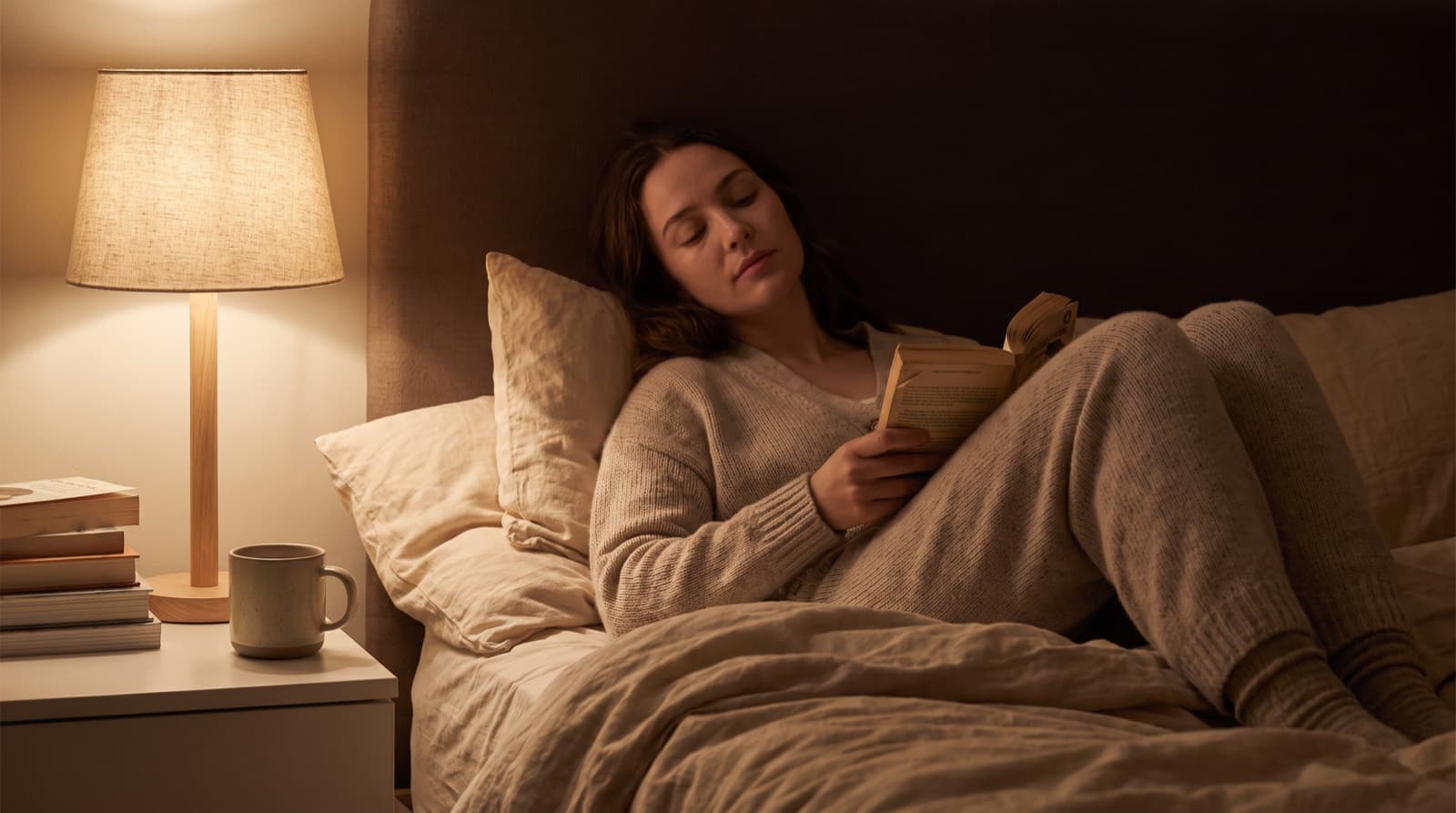
A good book is one of the oldest sleep aids we have. But the device you read it on may matter more than the story itself. The same page of a novel can leave you pleasantly drowsy or quietly wired, depending on whether the words sit on paper or glow from a screen an inch from your nose.
Reading is a genuinely good wind-down
Let's start with the good news. Reading before bed works. It gives your mind somewhere calm to go, pulls your attention away from the day's loose ends, and signals that the busy part of the evening is over. A steady, low-key routine like this is one of the friendliest cues you can give your body that sleep is coming.
Whether you turn paper pages or tap a screen, settling in with a story slows your breathing and eases you out of problem-solving mode. So the question is not whether to read. It is how to read in a way that does not undo the calm you are building.
Why a glowing page is different from a printed one
Here is where paper and screens part ways. A printed book reflects whatever light is already in the room. A phone, tablet, or backlit e-reader makes its own light and aims it straight at your eyes — often bright, often blue-rich, and often held close.
The cells that mistake your screen for morning
Your eyes carry special light-sensing cells whose only job is to tell your brain how bright and blue the world is right now. They do not care about words; they care about light. When you flood them with a bright, cool glow late at night, they can send the same message the morning sun sends — that it is daytime and you should be awake. That signal can nudge your melatonin later and leave you reading long past the point where a paper book would have let you drift off.
Research on light before bed points the same direction. Light-emitting readers used in the hour before sleep are associated with taking longer to feel sleepy and a later shift in the body clock than reading print. The effect is not dramatic for everyone, but it runs the wrong way for a habit meant to help you sleep.
If you love your screen, read on it kindly
None of this means you have to give up your e-reader or reading app. It means shaping the light so it works with your evening instead of against it. A few small settings do most of the work.
Dim it well below daytime
Turn the brightness far down, lower than feels natural at first. In a dark room your eyes adjust quickly, and a dim page sends a far weaker wake-up signal than a bright one.
Warm the color
Switch on night mode or a warm, amber filter so the screen shifts away from cool blue toward candle-like tones. This is the single change that most reduces the daytime message reaching your eyes.
Read in a dim room
Skip the bright overhead light. A small, warm lamp beside you lets the whole scene stay dark, so your screen is not the one bright thing your brain has to explain.
If you want the bigger picture behind these tweaks, it helps to know why evening light keeps you awake in the first place.
Physical books, e-ink readers with the front light off, and audiobooks all sidestep the glowing-screen problem. If a paper book is not practical, e-ink in a dark room is the next best thing.
So which one wins
For most people, a paper book is the safer bedtime choice, simply because it adds no light of its own. It reflects the soft lamp you have already dimmed and asks nothing extra of your body clock.
But the honest answer is that the best format is the one you will actually reach for night after night. If that is a screen, you are not doomed — you just have a little setup to do. Dim it, warm it, and keep the room dark, and a screen can be a gentle companion rather than a bright interruption.
The goal is the same either way. You want the last thing your eyes take in before sleep to whisper night, not shout morning. Get that right, and the story can do its quiet work.
References
- Sleep Foundation — Light and Sleep Sleep Foundation ↗
- Harvard Health — Blue light has a dark side Harvard Health ↗
- NIH NIGMS — Circadian Rhythms NIH ↗
Placeholder bio. Jordan translates sleep and nutrition research into practical guidance. Replace with a real contributor before publishing.
Read full bio →