You brushed your teeth an hour ago. You're exhausted. And yet the second your head hits the pillow, your brain flips back on — replaying the day, planning tomorrow, wide awake at 11:40pm. Sound familiar?
Most people blame stress, caffeine, or "just being a bad sleeper." Those matter. But there's a quieter culprit that hides in plain sight every single evening, and it has nothing to do with willpower.
It's the light.
The problem isn't discipline — it's a biological signal
Deep in your eyes sits a set of light-sensing cells called ipRGCs. They aren't the cells you see images with. Their only job is to measure light and report back to your brain's master clock. And they are tuned almost perfectly to blue-green light, responding most strongly around 480nm.
Here's the catch. Your brain evolved over millions of years where the only bright, blue-rich light came from one place: the sun. So the rule your body still follows is brutally simple — blue light means daytime, and daytime means stay awake.
When those cells detect blue light in the evening, they send a message to the master clock that essentially says, "The sun's still up." In response, your brain holds back melatonin, the hormone that quietly tips you into sleep.
In a controlled study, people reading on a light-emitting device before bed took longer to fall asleep, had suppressed melatonin, and felt less alert the next morning than those reading a printed book. The light didn't just cost them sleep that night — it shifted their body clock later.
Why evenings are the danger zone
The band of light your brain reads as "daytime" runs roughly from 400 to 530nm — and that's exactly the range screens, LED bulbs, and overhead fixtures pump out most. Your phone six inches from your face at 10pm is, biologically speaking, a small sunrise.
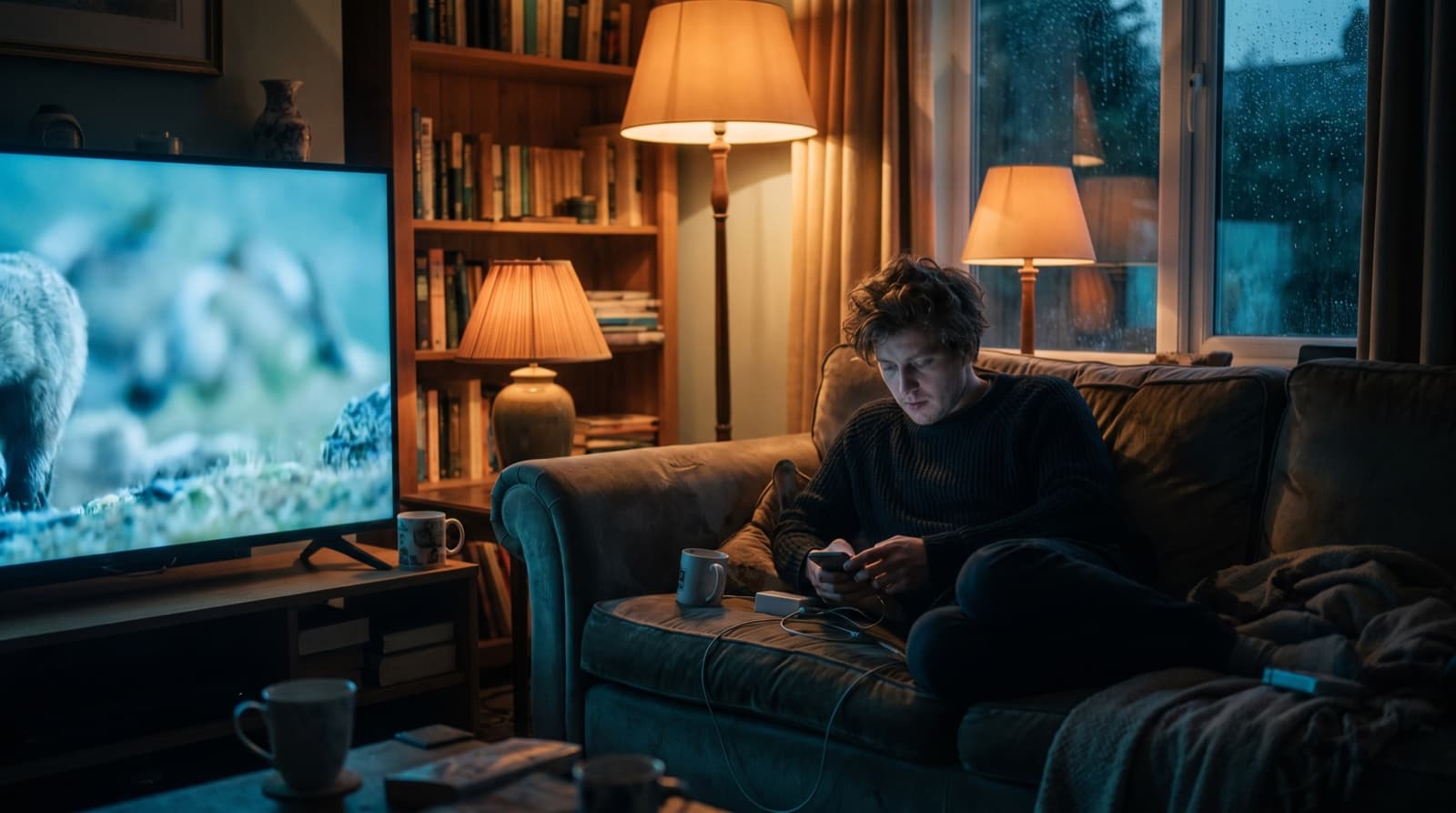
The result is a state you probably know well: tired but wired. Your body is worn out, but your brain has been told it's still daytime, so it keeps you alert. You lie there. You check the time. You get frustrated, which spikes cortisol, which wakes you up more.
And modern evenings are relentless about it — TV, then phone, then a bright bathroom, then a lamp by the bed. Every one of those is a fresh dose of the exact signal that delays sleep.
The three ways people try to fix this (only one is realistic)
Avoid all screens after dark
The advice you'll read everywhere. It works — and almost nobody does it. Telling a tired human to give up their phone, their show, and their kindle every night is a plan built to fail.
Night mode and dimming
Warm, dim screens help a little. But night-shift settings still let through a meaningful chunk of the disruptive band — and do nothing about the bright bulbs in your bathroom and bedroom.
Filter the light at your eyes
Instead of changing every screen and bulb, you change what reaches your eyes. Amber-tinted lenses absorb the wavelengths that carry the daytime signal — so you keep your screens on and still wind down.
For most people, option three is the only one that survives contact with real life. You put the glasses on after dinner. That's the whole habit.
Not all blue-light glasses are equal
Here's where it gets frustrating. Most "blue-light glasses" sold online are barely doing anything. Independent testing has found that many clear-lensed pairs filter only 5–20% of the relevant light — and often only the blue band, ignoring the green light that also matters after sunset.
If you're going to filter light to protect your sleep, a few things actually matter:
Covers the right band — including green
After sunset, the useful target runs all the way to about 570nm. Blue-only lenses leave a gap.
Filter in the lens, not sprayed on top
Surface coatings scratch off and fade. Pigment embedded in the lens itself is consistent and durable.
Lab-measured, not marketing
A claim like blocks blue light means nothing without a third-party measurement behind it.
You can actually live in them
A good evening lens softens light without turning the world unusable.
How Parlay Dusk compares
| Parlay Dusk | Cheap blue-light glasses | No glasses | |
|---|---|---|---|
| Filters the blue + green band | ~99%, 400–570nm | 5–20%, blue only | |
| Built for evening wind-down | not tuned for night | ||
| Pigment embedded in the lens | surface coating | ||
| Third-party lab-measured | |||
| Keep your screens & lamps on | sit in the dark | ||
| Premium acetate + spring hinges |
Why we recommend Parlay
When we hold blue-light eyewear to the criteria above, Parlay Optics is the pair we keep coming back to — and the one we send friends to.
Parlay makes two lenses for two jobs. The Everyday lens filters 95% of stimulating blue light across 400–465nm; it's the lighter amber tint you can wear at your desk without your screens looking strange. The Dusk lens is the one that matters for sleep: it filters roughly 99% of blue and green light across the full 400–570nm band. That deeper amber tint is designed to create a kind of virtual darkness after sunset — so your brain gets the "night" signal even with the lights on.
Crucially, Parlay embeds the pigment in the lens rather than coating the surface, and publishes third-party lab measurements rather than round numbers. It's the difference between eyewear built for your circadian rhythm and a novelty with a blue sticker on the box.
What Parlay customers say
4.9 (71)“I was skeptical at first but these glasses have completely changed my nighttime routine.”
“I use these at night when watching TV or scrolling and I fall asleep so much faster now.”
“I yawn almost every time I put them on at night. These are legit.”
 ★ Most Popular
Parlay Day/Night Set
Everyday 95% (400–465nm) for daytime · Dusk ~99% (400–570nm) for evening.
Designed to support your body clock across the whole day — steady focus by day, an easier wind-down by night.
- Everyday for work, Dusk for wind-down — the whole system.
- Premium acetate frames with spring hinges and a balanced fit.
- Save $44 vs. buying the lenses separately.
14-Day Trial — love them or a full refund
365-Day Warranty — damaged or defective? replaced
Free Returns — free shipping, both ways
Advertising disclosure. Better Sleep Daily is supported by its partnership with Parlay Optics. When we recommend a product, we may earn a commission — but we only recommend what meets our evidence standards.
Choose your setup
Most people start with the Day/Night Set.
- Filters ~99% of blue + green light
- Premium acetate frame
- 14-day trial · 365-day warranty
- Both lenses: work by day, wind-down by night
- Free shipping, both ways
- 14-day trial · 365-day warranty
- Filters 95% of stimulating blue light
- Premium acetate frame
- 14-day trial · 365-day warranty
Build a wind-down that actually sticks
Glasses aren't magic, and we'd never pretend one product fixes sleep on its own. The people who sleep best stack a few small, boring habits:
- Put the evening lenses on after dinner and leave them by the couch so you can't forget.
- Drop your indoor lighting in the last hour — lamps over overheads.
- Anchor your wake time, even on weekends. A steady morning does more for your clock than a perfect bedtime.
- Get bright light in the morning. The same system that hurts you at night helps you when you feed it real daylight early.
Do those four things and you're working with your biology instead of against it. The light goes out, the signal changes, and — most nights — your brain finally gets the message that it's okay to power down.
Frequently asked questions
Do I have to wear them every night? No, but consistency is where the payoff is. The habit works best when it's automatic.
Can I still watch TV and scroll? Yes — that's the entire point. The lenses filter the light so you don't have to give up your evening.
Will everything look orange? The Dusk lens has a warm amber tint by design. Most people stop noticing it within a night or two.
References
- Harvard Health Publishing. “Blue light has a dark side.” Harvard Medical School. Harvard Health ↗
- Chang A-M, et al. “Evening use of light-emitting eReaders negatively affects sleep, circadian timing, and next-morning alertness.” PNAS, 2015. PNAS ↗
- Sleep Foundation. “How Blue Light Affects Sleep.” Sleep Foundation ↗
- National Institute of General Medical Sciences. “Circadian Rhythms.” NIH / NIGMS ↗
Placeholder bio. Jordan translates sleep and nutrition research into practical guidance. Replace with a real contributor before publishing.
Read full bio →