
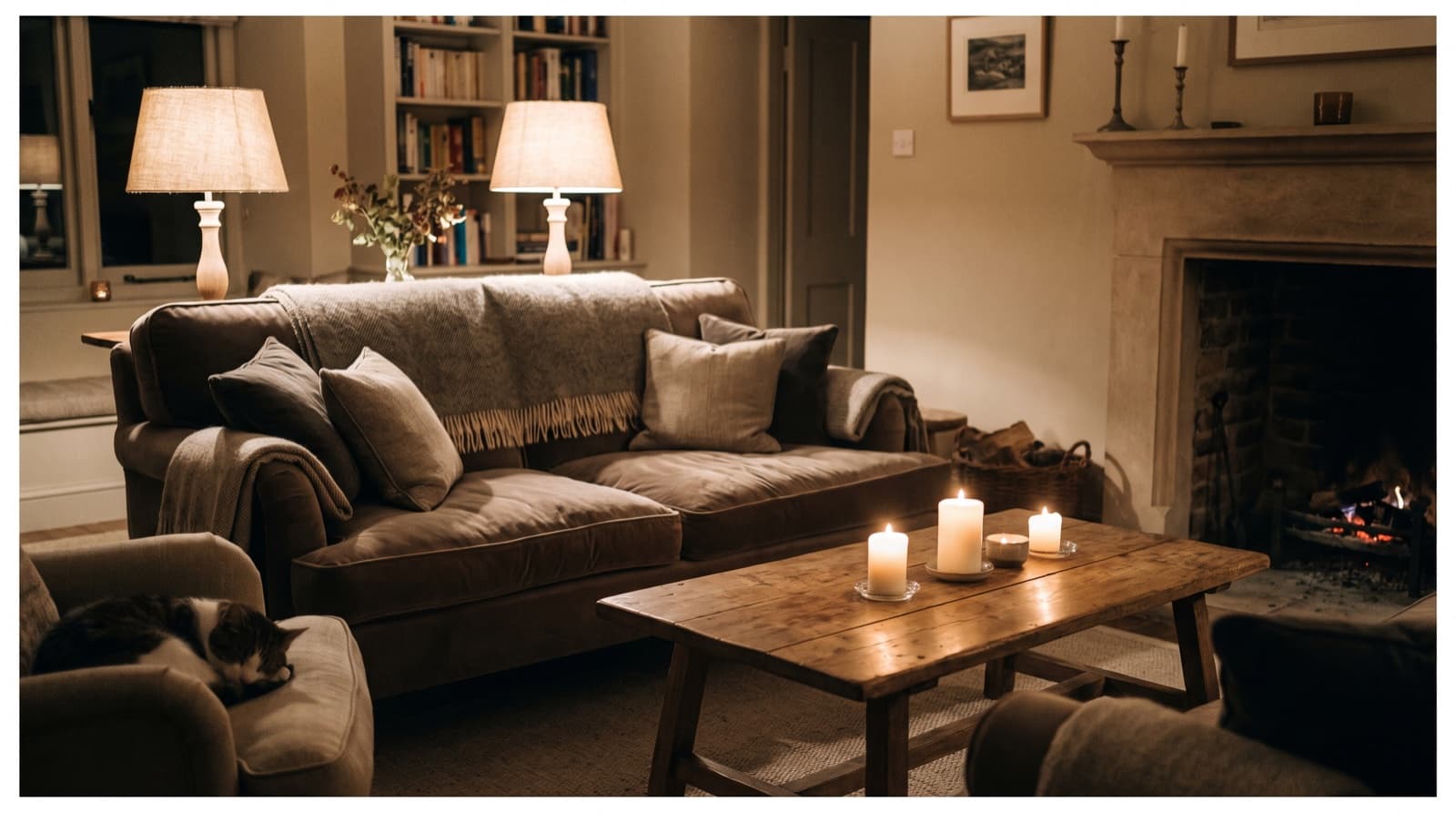
For most of human history, the light after sunset came from fire — low, warm, flickering, and never very bright. Our bodies learned to read that kind of light as a signal that the day was ending. The bright, even, overhead light we flip on every evening is a very recent invention, and while it is wonderfully convenient, it also asks your body to believe it is still midday long after the sun has set. Reaching for candlelight and lamps instead is a small change that works with your biology rather than against it.
Overhead light is a daytime habit
There is nothing wrong with bright overhead light during the day. It helps you feel awake, keeps a room feeling open, and makes it easy to see what you are doing. The trouble is that most of us never change the setting when night arrives. We cook, wind down, and get ready for bed under the same ceiling lights we used at noon, feeding our eyes a strong, cool, top-down glow at exactly the hour our bodies are trying to power down.
That matters because the cells that help set your body clock respond most to bright, blue-rich light from above — the same direction the midday sun comes from. Keep that light blazing all evening and you keep sending a daytime message, which can quietly delay the sleepiness you are hoping will arrive.
What low, warm light does after dark
Lamps and candles change three things at once: the brightness drops, the color warms, and the light moves lower in the room. Each of those shifts nudges your body toward evening. Warm light carries less of the blue wavelengths your clock reads as daytime, and light that sits at table height rather than overhead mimics the way natural light lowers and reddens as the sun goes down.
There is a mood dimension too, and it is not trivial. A room lit by a couple of warm lamps simply feels calmer than one lit by a bright ceiling fixture. That sense of ease is part of the point — a relaxed mind settles more readily than a keyed-up one, so the ambiance and the biology are pulling in the same direction.
Build a warmer evening
Kill the overhead
When you start winding down, turn off the ceiling light entirely. This single move removes the brightest, coolest, most daytime-like source in the room.
Bring the light down low
Switch on lamps at table and floor height instead. Light coming from below eye level feels softer and more like the low sun of late evening.
Go warm, real or bulb
Use warm-toned bulbs, or light a few candles where it is safe. The amber glow sits close to firelight, which is the light our bodies know best after dark.
Keep it consistent
Make the switch around the same time each night. A repeated cue teaches your body to expect the wind-down, so it starts settling on schedule.
Real candles bring real fire risk. Never leave a flame unattended, keep it well away from anything that can catch, and put it out before you doze off. Flameless warm lights are a safe stand-in when you want the glow without the worry.
Ambiance is not just aesthetic
It is tempting to think of candlelight as purely decorative, something for special occasions. But the calm it creates is doing real work. A softer, warmer, lower-lit room lowers the overall intensity of light reaching your eyes and helps your surroundings match the hour, which supports the natural slide toward sleep. The beauty of it is a bonus, not the whole story.
Where to begin tonight
You do not need to overhaul your home to feel a difference. Pick the room where you spend the last hour of your day, switch off the overhead, and light it with one or two warm lamps instead. Notice how the space feels and how you feel in it. If you want to go further and dial in the exact color of your bulbs, our guide on warm light vs. cool light walks through the details.
Candlelight and lamps are not a step backward into the past. They are a simple way to give your evenings the kind of light your body has always understood — low, warm, and unmistakably the sign of a day drawing to a close.
References
- Sleep Foundation — Light and Sleep Sleep Foundation ↗
- Harvard Health — Blue light has a dark side Harvard Health ↗
- NIH NIGMS — Circadian Rhythms NIH ↗
Placeholder bio. Jordan translates sleep and nutrition research into practical guidance. Replace with a real contributor before publishing.
Read full bio →