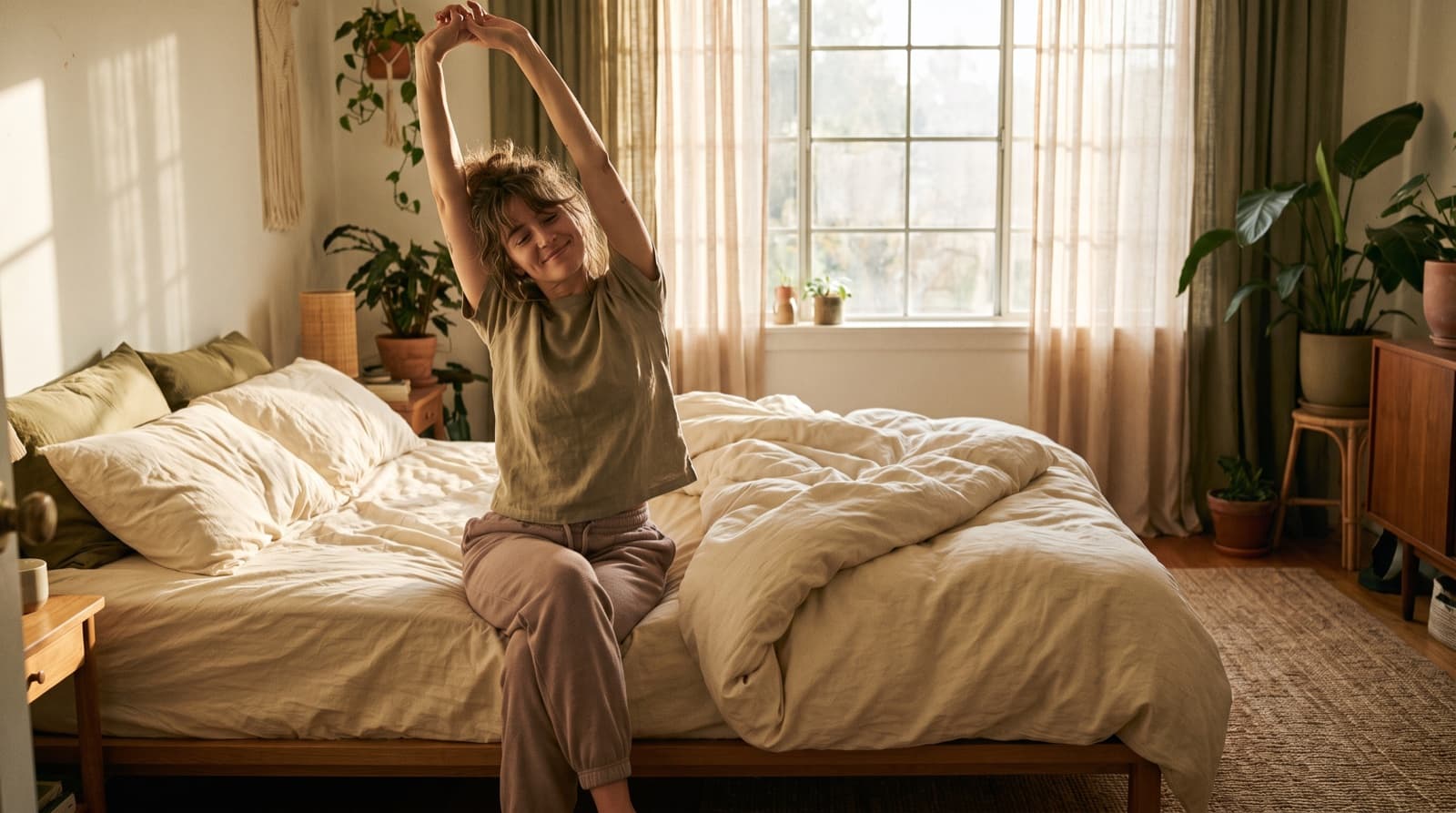
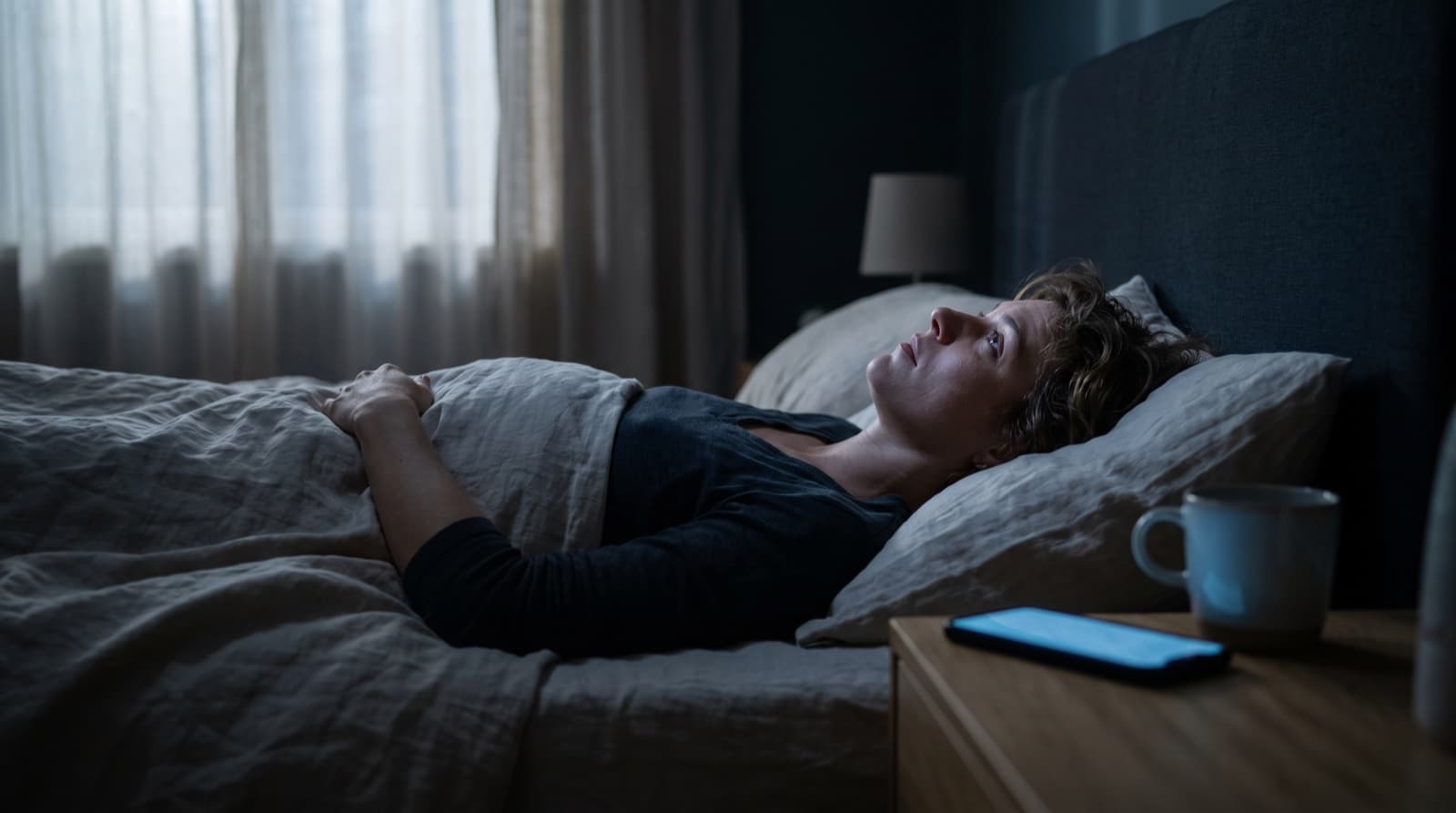
For about two years I was two different people. By 3 p.m. I was a zombie — foggy, reaching for a second coffee, counting the hours until I could lie down. Then I would finally get in bed, and like a switch flipped, I was wide awake. Replaying the day. Planning tomorrow. Staring at the ceiling at midnight, exhausted and completely wired.
If that is you, I wrote this for you. I tried basically everything, so here is the honest version — what actually helped, what did nothing, and the one thing that finally broke the cycle.
First, the free stuff that genuinely helped
I want to be straight with you before anything else: these cost nothing and they do work. Start here.
- Dim your lights after sunset. Swapping overhead lights for a couple of lamps in the last hour before bed made my evenings feel calmer almost immediately.
- Move your caffeine cut-off earlier. Caffeine has a long tail. Pushing my last cup to early afternoon took a week to notice, then it clearly helped.
- Keep the room cool. Somewhere around 65 to 68 degrees. Your body has to shed heat to fall asleep, and a warm room fights that.
- Wake up at the same time every day. Even weekends. This one anchored everything else — a steady morning did more than a perfect bedtime ever did.
- A little magnesium. Gentle, food-first, not a magic pill. It may help some people wind down; it was a small, real plus for me.
Do these and you are genuinely ahead of most people. For a few weeks, I felt a little better.
The part that took me way too long to admit
Here is the honest turn. None of it fully stuck — because every night I ended up on my phone in bed. And the thing that kept me wired was not the scrolling or the group chat. It was the light.
There are cells in your eyes whose only job is to read light and tell your brain what time it is. They are tuned to the blue and green light that screens and LED bulbs pump out after dark. When they catch that light at night, they send one message: the sun is still up. So your brain holds back melatonin, the hormone that makes you sleepy — and you get that maddening tired-but-wired feeling.
I did not want to hear it, because I was not going to give up my phone at night. And that is exactly why the fix that finally worked for me was not another rule to white-knuckle.
Why amber glasses, not another app
I had tried night mode. I had tried the “no screens” rule and lasted about three days. What finally worked was changing the light before it reached my eyes, so I could keep my screens and still wind down.
That is what an amber evening lens does — it filters the after-dark light that carries the daytime signal. And this is where the details matter, because most blue-light glasses barely do anything.
Independent testing has found many clear-lens pairs filter only 5 to 20% of the relevant light, and usually only the blue band. Parlay’s Dusk lens filters roughly 99% of blue and green light across 400 to 570nm. That is the specific range your brain reads as daytime — filter it after sunset and your evenings start to feel like night again. And those numbers are not marketing; they are third-party lab-measured.
How Parlay Dusk compares
| Parlay Dusk | Cheap blue-light glasses | No glasses | |
|---|---|---|---|
| Filters the blue + green band | ~99%, 400–570nm | 5–20%, blue only | |
| Built for evening wind-down | not tuned for night | ||
| Pigment embedded in the lens | surface coating | ||
| Third-party lab-measured | |||
| Keep your screens & lamps on | sit in the dark | ||
| Premium acetate + spring hinges |
The proof I actually cared about
I am naturally skeptical of sleep products, so I read the reviews before I bought. These are real customers, not actors:
What Parlay customers say
4.9 (71)“I was skeptical at first but these glasses have completely changed my nighttime routine.”
“I use these at night when watching TV or scrolling and I fall asleep so much faster now.”
“I yawn almost every time I put them on at night. These are legit.”
The honest offer
Here is exactly what you get, no countdown-timer games:
If you would rather just look for yourself, you can see the Dusk lens here. Put them on after dinner and keep doing whatever you normally do in the evening.
What actually changed (and what didn’t)
I want to be fair, because I hate overpromises. I still have late nights. This is not a cure and I would not trust anyone who called it one.
But the wired-at-midnight feeling is mostly gone. I fall asleep without the hour of lying there frustrated, and mornings stopped feeling like a hangover. Stacked on top of the free basics above, the glasses were the piece that finally made the rest of it hold. Give it about a week of wearing them in the evening before you judge it.
That is the whole story. If your nights sound like mine did, the Dusk lens is the thing I wish someone had handed me two years ago.
Advertising disclosure. Better Sleep Daily is supported by its partnership with Parlay Optics. When we recommend a product, we may earn a commission — but we only recommend what meets our evidence standards.
This article is advertising and reflects one person’s experience. It is general information, not medical advice, and results vary. If sleep problems are affecting your life, talk with a qualified healthcare professional.
References
- Harvard Health Publishing — Blue light has a dark side Harvard Health ↗
- Sleep Foundation — How Blue Light Affects Sleep Sleep Foundation ↗
- PNAS — Evening use of light-emitting eReaders and sleep PNAS ↗
Placeholder bio. Casey writes first-person, tried-it-myself sleep stories for Better Sleep Daily. Replace with a real contributor before publishing.
Read full bio →