
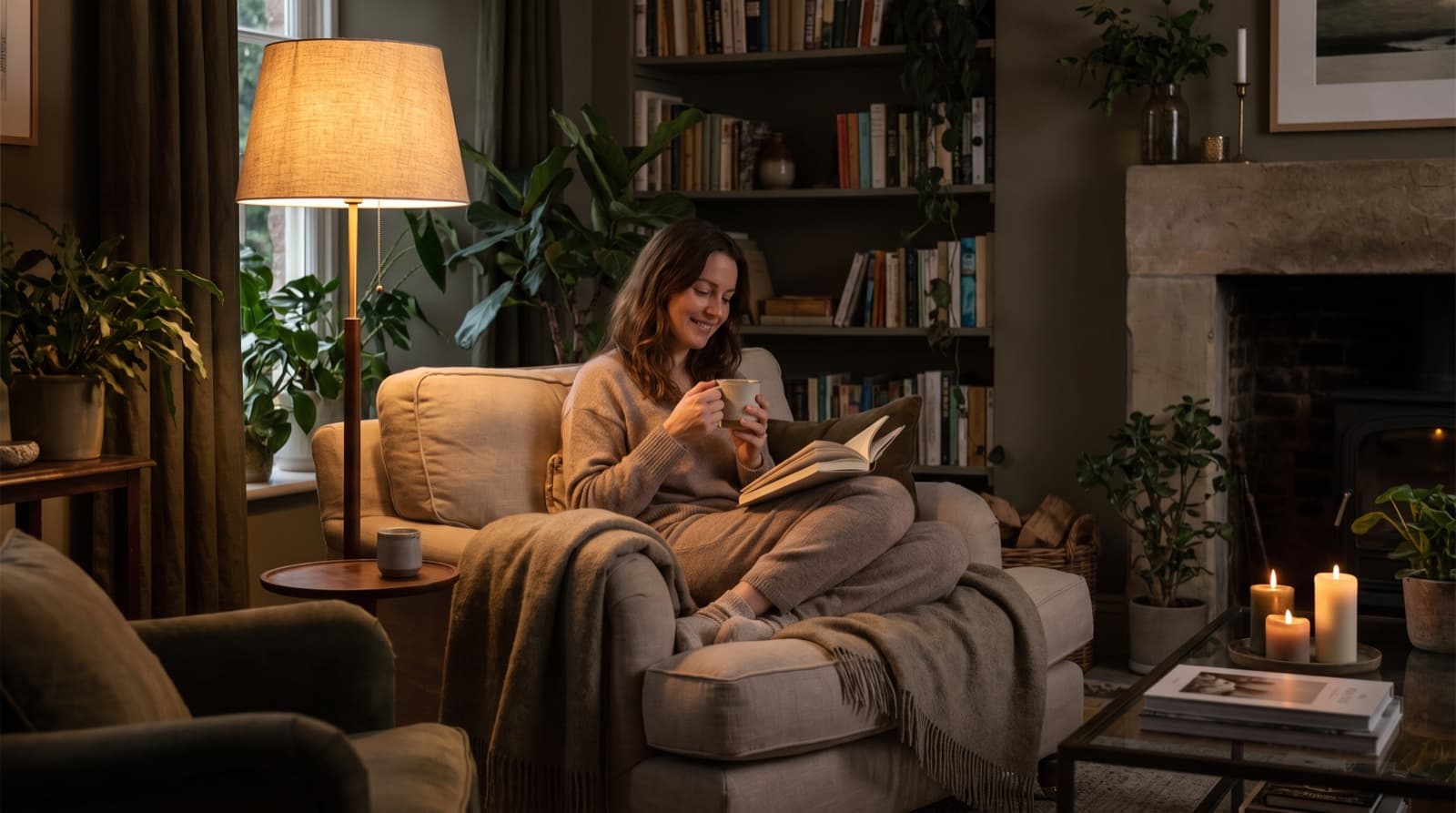
The hour before bed is doing more than you think. Long before your head touches the pillow, your body is quietly reading the room for an answer to one question — is it still day, or is it finally night? Give it a clear, consistent answer and sleep tends to follow. Give it a confusing one — bright screens, overhead lights, a mind still sorting through tomorrow — and it stays half-convinced the day is not over. The encouraging part is that this final stretch is highly trainable. You do not need more willpower so much as a repeatable pattern. Here is a blueprint you can eventually run on autopilot.
Why the last hour carries so much weight
Your body winds down on a schedule set largely by light. As evening arrives and your surroundings dim, your brain begins releasing melatonin, the hormone that ushers in sleepiness. Bright, blue-rich light in the evening can push that release later, which is part of why a well-lit living room and a glowing phone can leave you wired past midnight. The last hour is your chance to clear those mixed signals so the natural wind-down can proceed. Think of it less as a strict ritual and more as clearing the runway.
Consistency is the quiet ingredient. A body that lowers the lights and heads to bed around the same time each night learns to anticipate sleep, so drowsiness tends to arrive on cue instead of on request. That predictability is what turns a good night from a lucky accident into something closer to a habit.
A simple blueprint for the final 60 minutes
Dim the lights
About 45 minutes out, drop the brightness across your home. Switch off overheads, lean on lamps, and let the space feel like dusk. Lower light is the first cue that night has arrived.
Soften the screens
Set devices to their warm night mode, lower the brightness, and hold them a little farther from your face. Better yet, trade the phone for something offline once the hour begins.
Warm shower, cool room
A warm shower helps your body shed heat afterward, and that gentle drop in core temperature tends to nudge you toward sleep. Keep the bedroom cool and dark to match.
Land on something calm
Read a few pages, stretch, journal, or breathe slowly. A predictable, low-stimulation activity signals that the day is closing and there is nothing left to solve tonight.
None of these steps demand much once they become a sequence. The trick is to let one flow into the next so the whole hour runs like a familiar song, each cue setting up the one after it.
Anchor the blueprint to a fixed time rather than a feeling. Deciding in advance that the lights go down at, say, 9:45 removes the nightly negotiation and lets your body clock settle into a rhythm it can count on.
Make it yours
Not every step fits every night, and that is fine. If you work late, shrink the hour to thirty focused minutes. If you share a space, claim one dim corner as your wind-down zone. The aim is a repeatable pattern your body can recognize, not a flawless performance. For a deeper walk-through of each stage, see the ideal wind-down routine.
When screens will not budge
Some evenings you genuinely cannot go dark — a late email, a show you share with your partner, a scroll you are not ready to give up. On those nights, focus on softening the light rather than banning the screen. Warm display modes, lower brightness, and evening glasses that filter blue-rich light all help keep the signal gentler while you finish up. It is a compromise, not a failure, and a softly lit hour beats a harshly lit one every time.
Give it a week
New routines feel clumsy for the first few nights and nearly automatic by the end of the week. Resist judging the blueprint after a single attempt. Instead, run it for seven evenings and notice how quickly the sequence starts to feel like the natural close of the day. Most people find the hardest part is simply starting on time — everything after the first dimmed lamp tends to carry itself.
The last hour before bed is not about doing more. It is about doing less, more consistently, in lower light. Clear the runway, keep the timing steady, and let your body do what it already knows how to do.
References
- Sleep Foundation — Light and Sleep Sleep Foundation ↗
- Mayo Clinic — Sleep tips 6 steps to better sleep Mayo Clinic ↗
- NHLBI — Healthy Sleep Habits NHLBI ↗
Placeholder bio. Morgan oversees editorial standards and the fact-check process. Replace with a real editor before publishing.
Read full bio →