
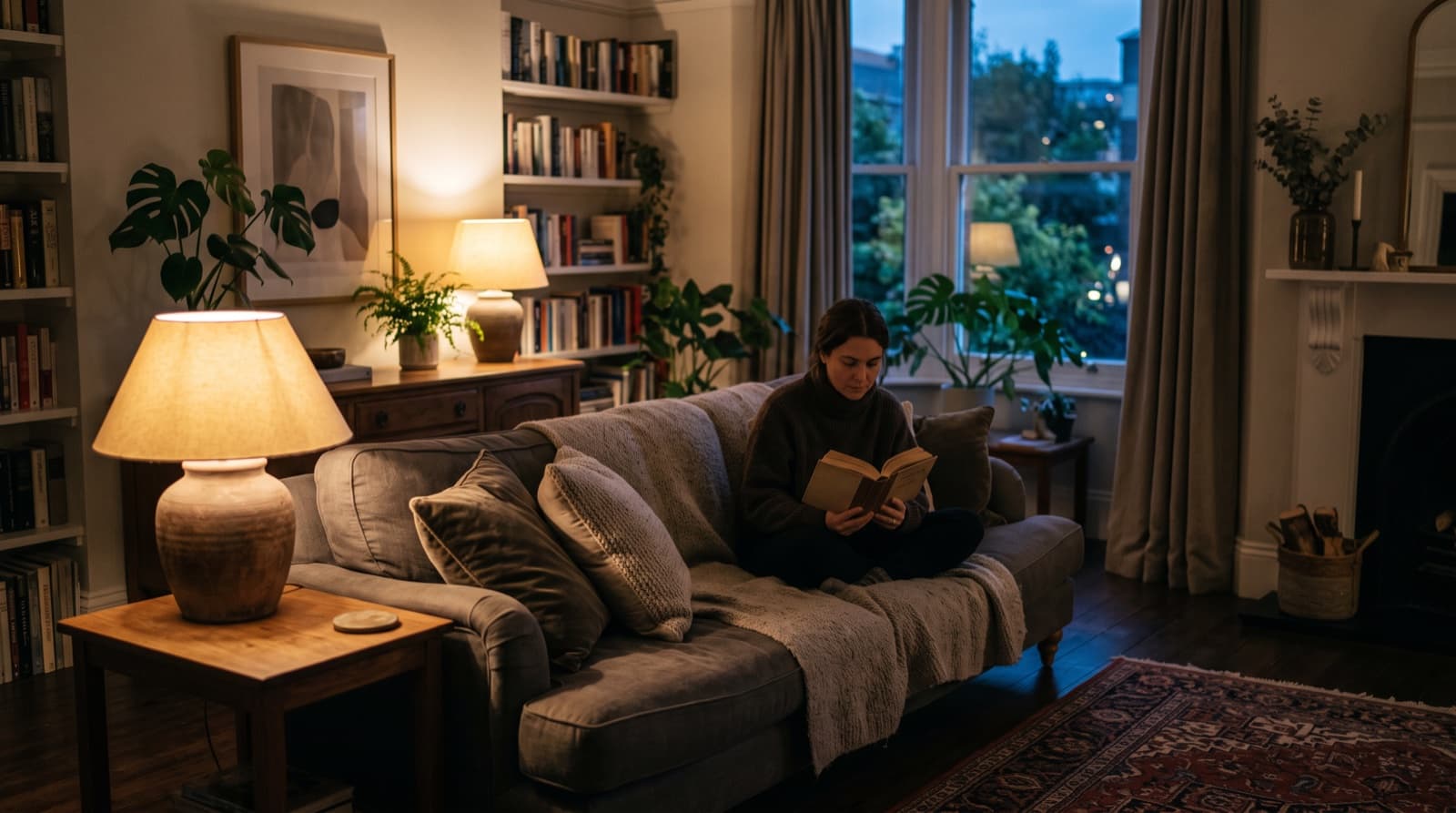
Most sleep advice focuses on what you do right before bed. But the environment you sit in for the hours leading up to it matters just as much, and the biggest, most overlooked lever in that room is the light on the ceiling. Your home's evening lighting is quietly telling your body whether it is daytime or nighttime — and for most of us, it is shouting daytime long after the sun goes down.
Your living room thinks it is noon
The light-sensing cells in your eyes do not know the difference between sunlight and a bright bulb. They simply measure how much light is around and report it to your body clock. A typical living room, lit up with bright overhead fixtures, delivers far more light than your rhythm expects after dark. To your brain, sitting under those lights at ten at night looks a lot like standing outside at midday.
The result is a delay. Bright evening light can push back the release of melatonin, the hormone that ushers you toward sleep, leaving you alert when you would rather be drifting off. The fix is not to sit in total darkness — it is to lower the volume of light so your body can finally hear the night signal.
The last hour is the one that counts
You do not need to overhaul your whole evening. The final sixty to ninety minutes before bed are where dimming pays off most. That is the window when your body is trying to shift into sleep mode, and it is the window most easily disrupted by a wall of bright light.
Trade the ceiling for the lamps
The single easiest change is to stop lighting your evenings from overhead. Bright ceiling fixtures blast light straight down into your eyes, right where those light-sensing cells are watching. Lamps placed low and around the room cast a softer, warmer pool of light that is far gentler on your rhythm.
Warm color matters too. Cooler, bluer light carries a stronger daytime signal, while warm, amber-toned light is friendlier to the evening. Many bulbs are labeled with a color temperature, and choosing warmer tones for the rooms you use at night is a small swap with an outsized payoff.
Smart and dimmable bulbs make all of this nearly effortless. You can set them to fade and warm automatically as the evening goes on, so the room drifts toward night without you thinking about it. If a full smart setup is not for you, even a simple dimmer switch or a couple of warm lamps will move you most of the way there.
Kill the overheads
An hour before bed, switch off bright ceiling fixtures and light the room with lamps at or below eye level instead. Instantly softer, instantly calmer.
Go warm and low
Choose warm, amber-toned bulbs for evening rooms and dim them as far down as you comfortably can. Warm and low reads as night to your body.
Automate the fade
Set smart bulbs to dim and warm on a schedule, or lean on a dimmer, so your home eases into night on its own every evening.
Do not forget the screens sharing the room with you. A dim home helps most when your phone, tablet, and television are dimmed and warmed too, so one bright rectangle is not undoing all your careful lighting.
Build it into a routine you actually keep
Dimming your home works best as an automatic cue rather than a nightly decision. When the lights go warm and low at the same time each evening, your body starts to treat that shift as the opening move of sleep. It becomes a signal you no longer have to think about — the room changes, and your brain quietly begins to wind down with it.
That is why lighting fits so naturally into the ideal wind-down routine. It pairs with everything else you already do to settle in, and it asks almost nothing of you once the bulbs and timers are set.
You cannot control the light everywhere you go, but your home in the last hour of the day is entirely yours to shape. Lower it, warm it, and let the lamps do the talking. Of all the evening habits that support better sleep, dimming the room may be the simplest one you can start tonight — and one of the most rewarding to keep.
References
- Sleep Foundation — Light and Sleep Sleep Foundation ↗
- Harvard Health — Blue light has a dark side Harvard Health ↗
- NIH NIGMS — Circadian Rhythms NIH ↗
Placeholder bio. Morgan oversees editorial standards and the fact-check process. Replace with a real editor before publishing.
Read full bio →