
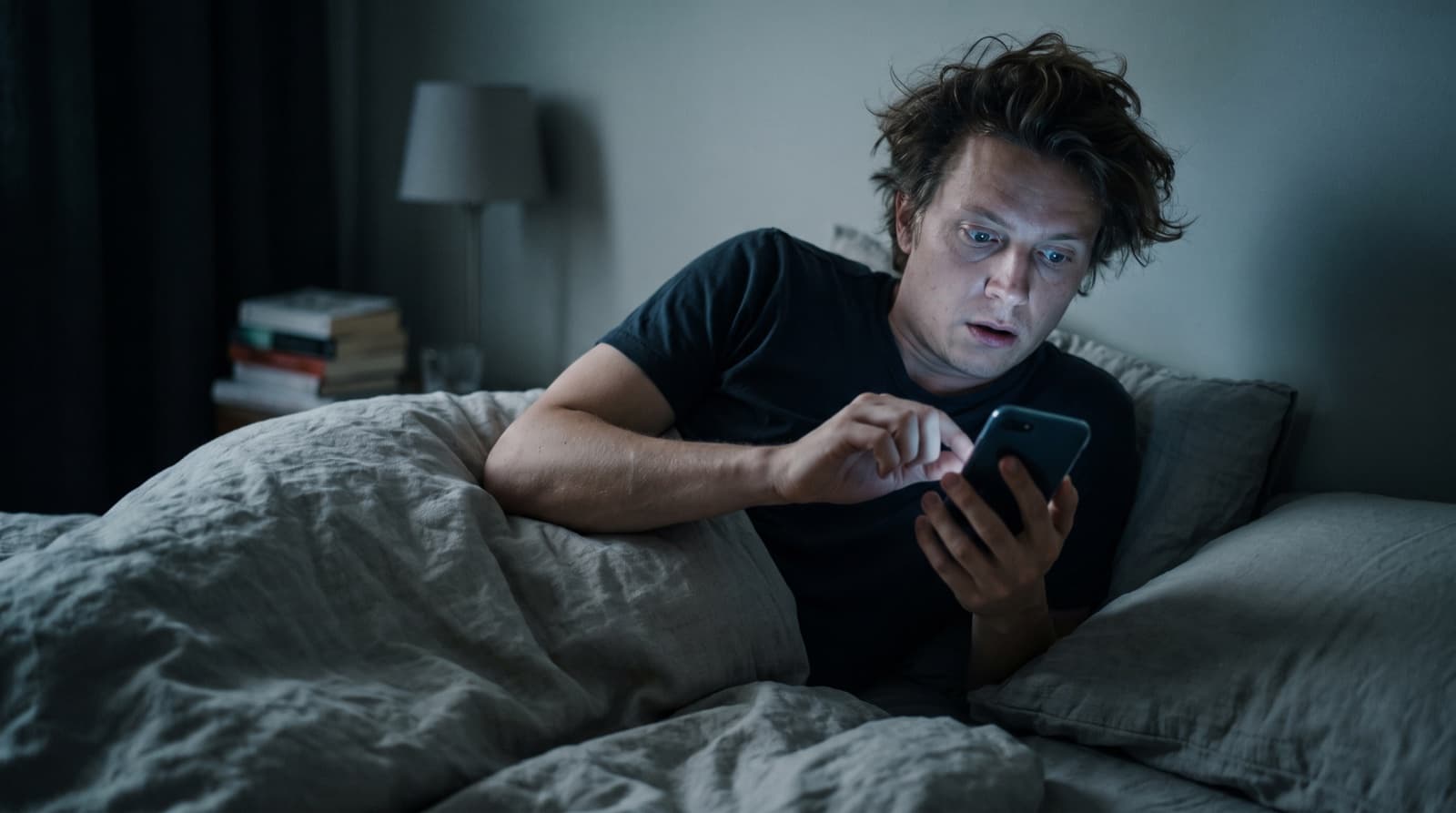
You know the feeling. You told yourself “five minutes,” and now it's 12:20am, you're still scrolling, and you're somehow more awake than when you got into bed.
It's easy to blame the content — the doom-scrolling, the group chat, the one more episode. And yes, engagement is designed to keep you up. But there's a second, quieter reason your brain won't shut off after screen time, and it's purely physical.
The two-part problem
Part one is attention. Feeds are built to hold you. That's a real problem, and setting a cut-off time genuinely helps.
Part two is light — and this is the part almost nobody accounts for. Your phone and laptop emit light in the blue-green range your brain uses to tell time. Held close to your face in a dark room, a screen is a surprisingly strong signal that says it's daytime, stay alert.
The disruptive range your body reads as “daytime” runs roughly from 400 to 530nm — squarely where phone and laptop screens put out the most light. That's why a dim, warm paperback feels different at midnight than a bright feed.
Why “night mode” isn't enough
Warm-tone and night-shift settings help a little, and you should use them. But they still let through a meaningful slice of the disruptive band, and they do nothing about the other lights in your evening — the bright bathroom, the kitchen, the lamp you read under.
The most reliable move is to filter the light at your eyes, so it doesn't matter which screen or bulb it's coming from.
The realistic fix (that doesn't require willpower)
You don't have to become the person who reads by candlelight. Stack three small changes for the last hour before bed:
- Drop the brightness on every screen, and switch to warm tones.
- Dim the room — lamps instead of overheads.
- Filter the light with amber-tinted lenses made for evening, so your brain gets the “night” signal even with your phone on.
That last one is the cheat code. Put the glasses on, keep your show or your feed, and let your body wind down anyway.
What to expect
This isn't an overnight switch — give it a week of consistency. Most people notice the evening “wired” feeling soften first, then falling asleep starts to feel less like a fight. Pair it with a steady wake-up time and morning daylight, and you're working with your body clock instead of against it.
References
- Sleep Foundation. “How Electronics Affect Sleep.” Sleep Foundation ↗
- Harvard Health Publishing. “Blue light has a dark side.” Harvard Health ↗
- Cleveland Clinic. “Why You Should Ditch Your Phone Before Bed.” Cleveland Clinic ↗
Placeholder bio. Morgan oversees editorial standards and the fact-check process. Replace with a real editor before publishing.
Read full bio →