Some nights your body is clearly ready for sleep, but your mind keeps narrating. You lie still, you wait, and the harder you try to force it, the more awake you feel. This is the exact moment a simple breathing practice earns its keep, because your breath is one of the few parts of your nervous system you can steer on purpose.
Your breath talks to your nervous system
Underneath your awareness, an automatic control system runs day and night. One branch of it, the sympathetic side, revs you up — faster heartbeat, quicker breath, a background hum of alertness. The other branch, the parasympathetic side, settles you into rest and repair. Drifting off depends on that second branch taking the lead, yet the stresses of a long day often leave the first one stuck in the on position.
Here is the useful part. Breathing is the rare automatic function you can also run by hand, which makes it a back door into that control system. Slow, easy breathing — especially a long, unhurried exhale — encourages the calming branch to step forward. Your heart rate eases, your muscles loosen, and your body begins to read the moment as safe. This is not a trick that forces sleep on command. It simply clears away some of the arousal that stands between you and the sleep your body already wants.
Three patterns worth knowing
You do not need all of these. Pick one, try it for a few nights, and keep whichever feels most natural in the dark.
Slow breathing
Breathe in gently through your nose for about four counts, then out for six. The exact numbers matter less than the shape — keep the exhale longer than the inhale. Five or six rounds is enough to feel your shoulders drop.
The 4-7-8 pattern
Inhale quietly through the nose for four, hold for seven, then exhale slowly through the mouth for eight. The long hold and longer exhale give a busy mind a single, simple thing to track instead of tomorrow's worries.
The physiological sigh
Take one full breath in through the nose, add a second short sip of air on top, then let it all out in a long, slow exhale. Two or three of these can take the edge off tension in under a minute.
The exhale is the active ingredient, so let it be soft and complete rather than forced. If any pattern makes you feel short of breath or lightheaded, ease off the counts and simply breathe a little slower than usual.
When your body is calm but your room is not
Breathing lowers your internal arousal, but the room around you is still sending signals of its own. Bright, blue-rich light in the last hour before bed keeps that alert branch quietly switched on, working against every slow exhale you take. That is why the calmest breathing routine lands better in a dim room, with overhead lights down low and screens dimmed or filtered.
Think of it as two levers pulling the same direction — you soften the input from your surroundings while you soften the input from your breath. Managing your evening light is the setting, and breathing is the practice that fills it.
What breathing can and cannot do
It helps to be honest about the ceiling here. A breathing pattern is a tool for turning down arousal, not a switch that forces sleep. On a normal night it can shorten the gap between lying down and drifting off. On a night when your thoughts are truly spinning, it works best paired with other habits — a consistent wake time, a wind-down that starts before you are in bed, and a few minutes spent quieting a racing mind before your head hits the pillow.
It is also a far better first move than reaching for a pill. Breathing costs nothing, carries no morning grogginess, and you can use it any night without building a dependence. If you practice these patterns regularly and still find yourself wide awake and exhausted most nights, that is worth raising with a clinician rather than solving alone.
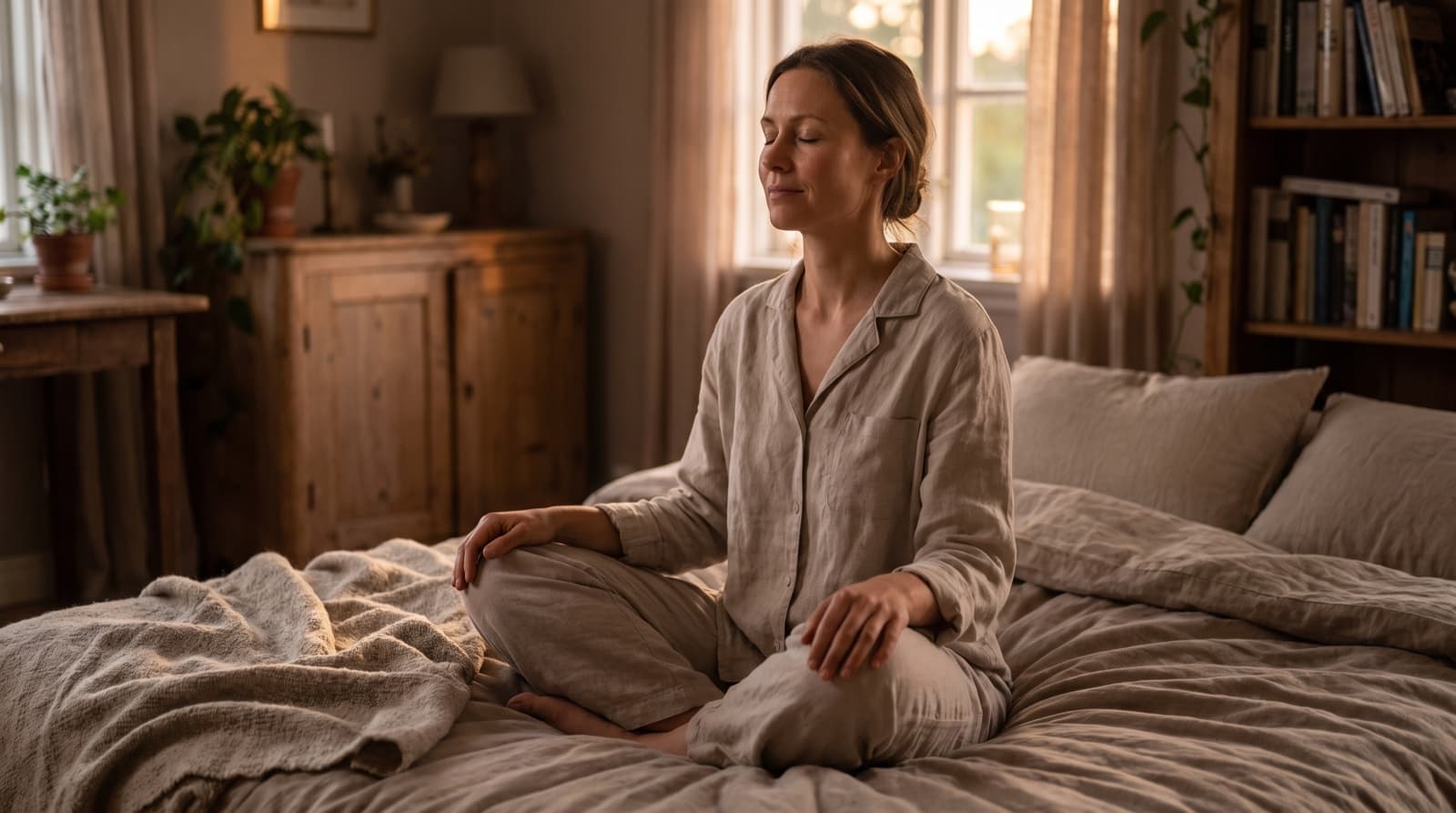
Start small tonight. Turn the lights down, get comfortable, and give yourself six slow breaths with a long exhale on each one. You are not trying to fall asleep on the very next breath — you are simply showing your body, one exhale at a time, that the day is finally over.
References
- Mayo Clinic — Relaxation Techniques for Stress Relief Mayo Clinic ↗
- Sleep Foundation — Relaxation Exercises To Help Fall Asleep Sleep Foundation ↗
- NIH NIGMS — Circadian Rhythms NIH ↗
Placeholder bio. Jordan translates sleep and nutrition research into practical guidance. Replace with a real contributor before publishing.
Read full bio →